Harvesting honey is the reward for a season of diligent apiary management. It is a sticky, labor-intensive, and immensely satisfying process. For first-year beekeepers, there is often an expectation of a large harvest, but it is critical to note that many colonies require all of their first-year honey stores to survive their first winter. If your colony has produced a surplus, however, the extraction process involves a specific sequence of operations to ensure the honey remains pure and the bees are minimally disturbed.
Determining Readiness and Timing
You cannot harvest nectar; you must wait until it becomes honey. Foraging bees bring floral nectar back to the hive at roughly 80% water content. Through a process of fanning and enzymatic breakdown, the colony reduces the moisture content to below 18%. At this point, the honey is cured, and the bees will seal the hexagonal cell with an airtight wax capping.
The Rule of Thumb: Only harvest frames that are at least 80% to 90% capped with wax. If you extract uncapped nectar, the high moisture content will cause the entire batch of honey to ferment and spoil in the jar. Harvesting typically occurs in late summer or early autumn, corresponding with the end of the local nectar flow.
Clearing the Bees
Before you can take the honey boxes (supers) into your extracting area, you must remove the bees. Pulling frames covered in agitated bees into a house or garage is a recipe for chaos. There are three common methods for clearing supers:
- Bee Brush: You can physically lift each frame and gently sweep the bees off back into the hive using a soft-bristled bee brush. This is tedious for large harvests but cost-effective for small ones.
- Fume Board: A felt-lined board sprayed with a safe botanical repellent (often smelling of almonds) is placed on top of the hive. The smell drives the bees downward into the brood chamber in about 5 to 10 minutes, leaving the honey supers empty.
- Escape Board (Porter Bee Escape): A one-way valve inserted between the brood boxes and the honey supers. Bees go down to tend the queen overnight but cannot figure out how to return upward. This is the gentlest method but requires two trips to the apiary 24 hours apart.
The Uncapping Process
Once the supers are safely indoors (in a bee-proof room, as local foragers will aggressively seek out the exposed honey), the extraction begins. The first physical step is breaking the wax seal the bees created.
Beekeepers use an uncapping knife—often an electric heated knife—to slice away the thin top layer of wax cappings. The frame is rested on a specialized uncapping tub that catches the wax and dripping honey. A cold, serrated knife or a specialized uncapping scratcher fork can also be used for low spots the knife misses. The resulting wax cappings are highly prized and can be melted down later for candles or cosmetics.
Extraction and Filtering
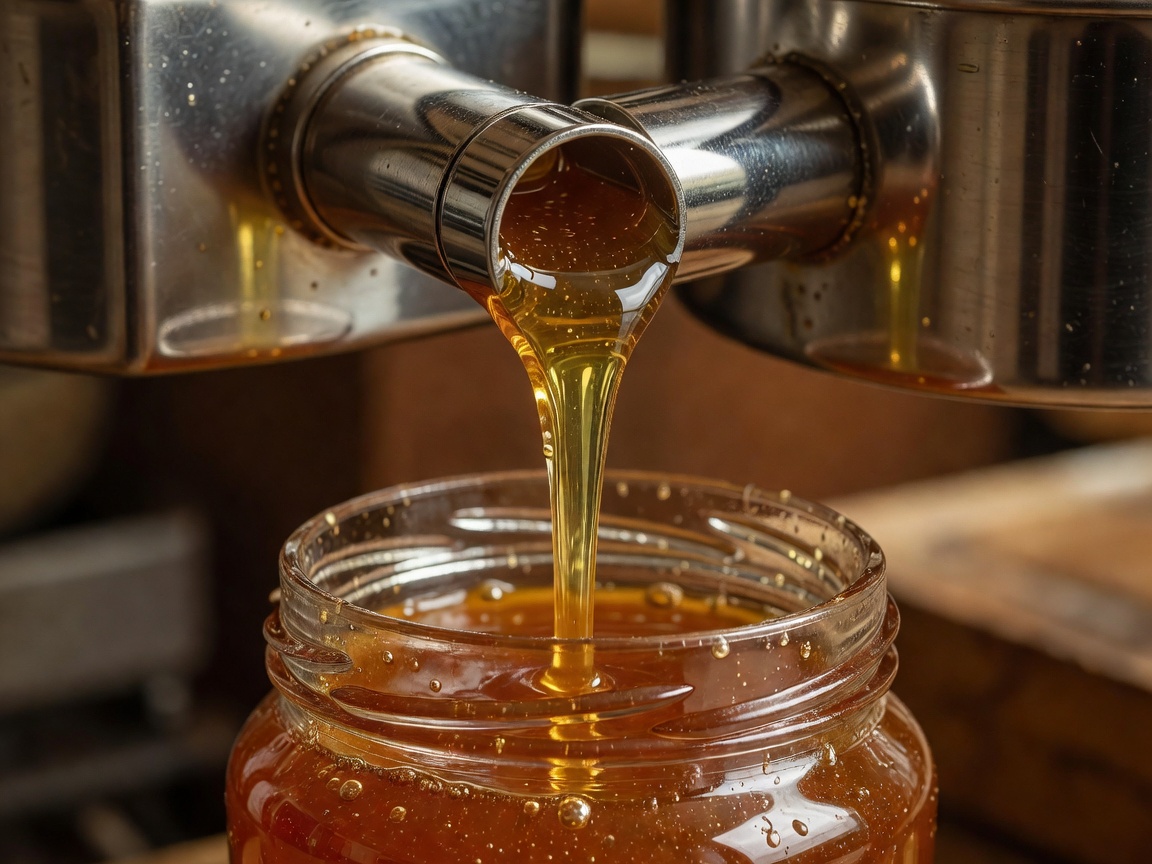
In standard Langstroth setups, the uncapped frames are placed into a centrifugal extractor. Extractors use centrifugal force to fling the heavy honey out of the comb and onto the stainless steel walls of the drum, where it drips down to a collection valve (honey gate) at the bottom.
There are two types of extractors:
- Tangential: The frame sits flat against the cage. You spin one side, stop, flip the frame manually, and spin the other.
- Radial: Frames radiate outward like the spokes of a wheel. Both sides are extracted simultaneously, saving significant time.
As the honey flows from the extractor gate, it must be filtered. The standard practice is a two-stage stainless steel sieve placed over a standard 5-gallon food-grade bucket. The coarse upper mesh catches stray wax chunks and occasional bee parts, while the finer lower mesh catches smaller particulate matter, leaving clean, raw honey in the bucket below.
| Container Size | Avg Weight of Honey | Frames required (approx) |
|---|---|---|
| 1 Pint Jar (16oz volume) | 1.5 lbs (24oz weight) | 0.5 Medium Frames |
| 1 Quart Jar (32oz volume) | 3.0 lbs (48oz weight) | 1 Medium Frame |
| 5 Gallon Bucket | 60 lbs | 20 Medium Frames (2 full supers) |
Settling and Bottling
Once filtered into a bucket (often fitted with its own honey gate at the bottom, called a bottling tank), the honey should be left to rest in a warm room for 24 to 48 hours. This settling period allows millions of tiny air bubbles introduced during the spinning process to rise to the surface, forming a thin foam.
After the honey has settled and the liquid below is clear, jars can be placed under the bottling gate and filled. Because raw honey naturally crystallizes over time, keeping the jars tightly sealed in a temperate environment is key to preserving its liquid state for as long as possible. The empty, sticky frames are then returned to the hive for the bees to clean and repair, completing the cycle.